The card statement shows a hotel charge from three weeks ago. The receipt is in someone's photo gallery. The business reason is in their head. And month-end is on Friday.
If that sounds familiar, you're not alone. When we surveyed 500 UK employees in 2025, almost three in ten said they're chased for missing receipts every week - and one in ten are chased every day.
Nearly every employee spend management problem comes down to the same thing: the gap between money leaving the business and finance seeing the full picture. The wider that gap, the more chasing, guesswork and month-end pressure your team absorbs.
This guide explains what employee spend management means, how to track employee spending in practice, which controls actually matter and where software earns its place - without creating more admin for anyone.
What is employee spend management?
Employee spend management is the process of controlling and tracking money spent by employees on behalf of the business, from expense claims and mileage to company card purchases. It covers the full spend journey: policy, approval, receipt capture, reimbursement or card reconciliation, and reporting - giving finance visibility and control over employee-initiated spend.
That word “journey” matters. Employee spend isn't a single event; it's a chain:
A policy sets the rules
Pre-approval happens where it's needed
The employee spends
The receipt and business reason are captured
An approver signs it off
The employee is reimbursed, or the card transaction is reconciled
The data lands in reporting and syncs to the accounting software
Good employee spend management is about control and visibility across that whole chain - not just recording expenses after the money has gone. If your process only starts when a claim arrives, you're managing history, not spend.
Employee spend management vs expense, business, and enterprise spend management
These terms overlap, but they're not interchangeable. Here's how they fit together:
Term | What it covers | Typical focus |
|---|
Expense management | Claims, receipts, mileage, reimbursements, and approvals | Processing what employees have already spent |
Employee spend management | All employee-initiated spend: claims, company card transactions, receipts, approvals, policy control, and reporting | Controlling and seeing spend across the full journey |
Business spend management | Wider company spend: supplier invoices, subscriptions, procurement, employee expenses, and payments | Company-wide cost control |
Enterprise spend management | Large-scale spend control across departments, entities, and regions | Complex organisations with layered approval and reporting needs |
In short: employee expense management is one part of employee spend management, which in turn sits inside broader business spend management.
Why is tracking employee spending harder than it should be?
Most finance teams aren't short of effort. The difficulty is structural - the process works against you in four ways.
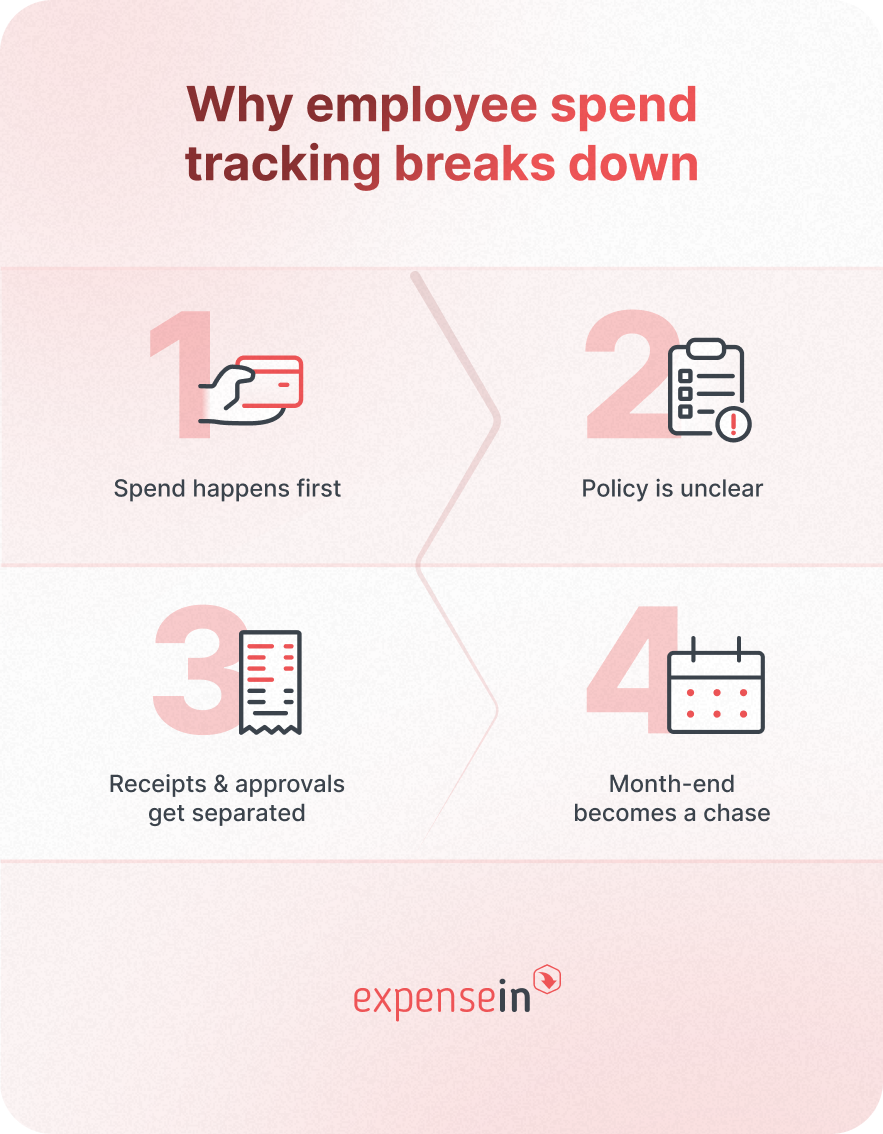 Spend happens before finance sees it
Employees book hotels, pay for client lunches, buy supplies, and tap company cards long before finance has any context.
By the time the claim or card statement arrives, the money has already gone. You're not controlling spend at that point - you're reconstructing it.
Policies are clear to finance, but unclear to employees
A policy in a PDF is not the same as a policy that guides spend at the point of submission.
The evidence shows up as recurring questions: claims without VAT receipts, meal costs that hover just over an unstated limit, client entertainment that nobody's sure how to code, mileage claims without journey details, and software subscriptions bought without anyone approving them.
None of this is bad faith. It's what happens when the rules live in a document nobody reads at the moment they spend.
Receipts, approvals, and card transactions get separated
The card statement proves money was spent. But the receipt might be in someone's inbox, the approval in a Teams message, and the business reason in their memory.
Every piece of context that lives in a different place is something finance has to chase, match, and file manually.
Month-end turns into a chase
Put those three together and month-end becomes predictable:
Research from the Global Business Travel Association found that around one in five expense reports contains errors or missing information - and each one takes an extra 18 minutes to put right. Multiply that across a year, and the cost of chasing becomes very real.
How to track employee spending properly
So, what does good employee spend tracking look like in practice?
These seven steps close the gap between spend and sight - each one moves visibility closer to the moment money leaves the business.
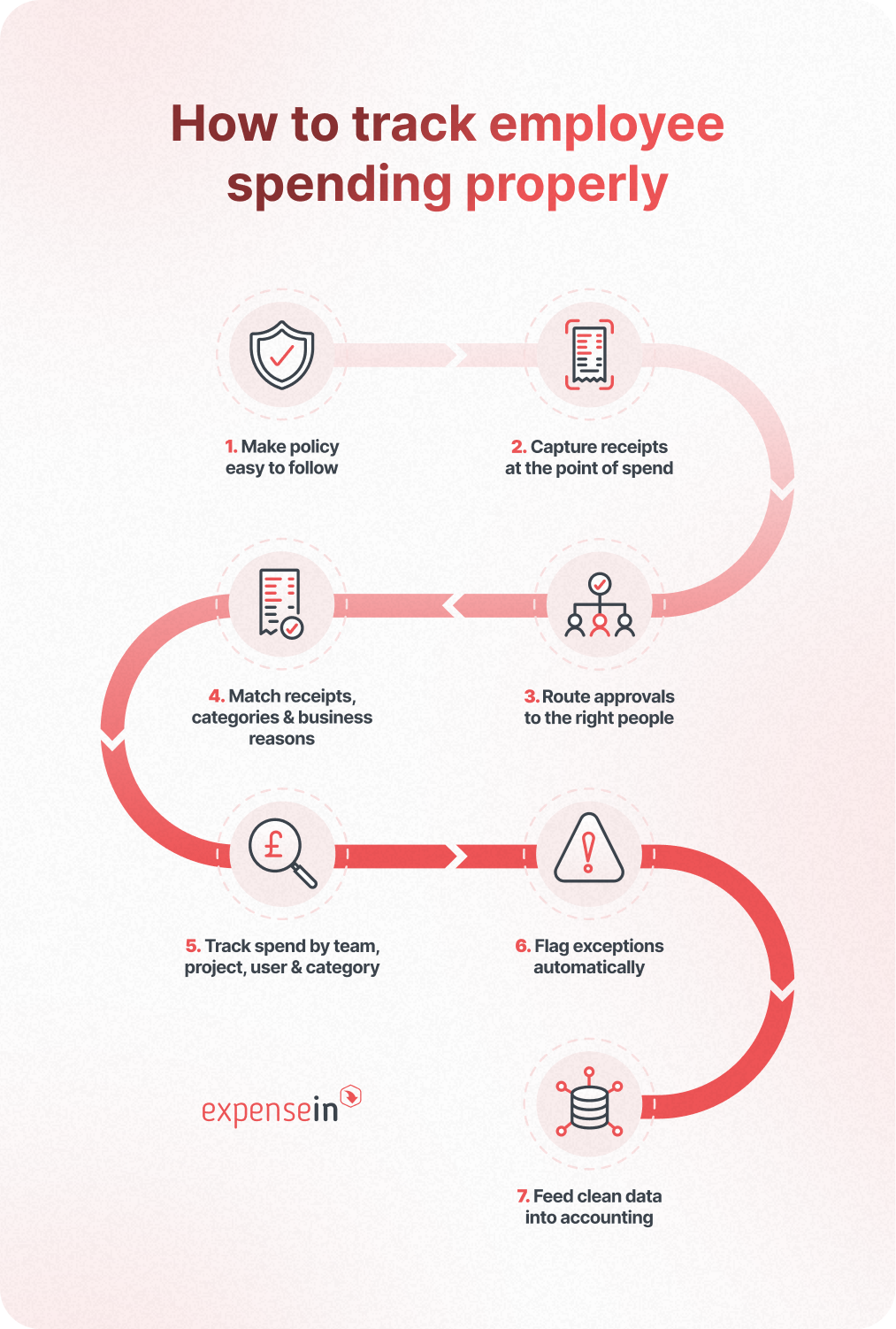 1. Start with a policy people can actually follow
Your expense policy should define:
Then make it short enough to remember and available where people spend - ideally built into the tool they submit through, not filed on the intranet.
 2. Capture receipts and context close to the transaction
The longer the gap between spending and submitting, the more likely finance is to chase context later.
Real-time or near-real-time capture - a photo of the receipt at the table, a mileage entry at the end of the journey - keeps the evidence attached while the details are fresh.
It also protects your VAT reclaims in both the UK and Ireland, because a missing receipt is usually a missed reclaim.
3. Route approvals to the right people
Separate the two kinds of approval:
Pre-approval works for planned purchases: travel, events, subscriptions, or anything over a set value.
Post-spend approval covers claims, card transactions and reimbursements.
Both should go to a named approver based on team, project or value - not to whoever happens to answer the email first.
4. Match receipts, categories, and business reasons
A clean record answers every question before it's asked.
For each transaction, finance needs:
The receipt
Category
Date
Amount
VAT
Tax information where relevant
The project
Department
Client or cost centre it belongs to
Who approved it
Whether it sits inside policy
If any of those arrive separately, someone has to match them later. That matching work is where employee spend tracking quietly consumes your team's time.
5. Track spend by team, project, user, and category
A total spend figure tells you almost nothing.
Patterns tell you everything:
Which teams are trending over budget
Which projects are absorbing unexpected costs
Which categories are creeping
Which individuals regularly submit late
Tracking employee spending at this level turns expense data from a record into a management tool.
6. Flag exceptions instead of checking everything manually
Reviewing every claim by hand doesn't scale, and it treats your most reliable submitters the same as your riskiest.
Instead, set rules that flag the exceptions:
Missing receipts
Spend above policy limits
Duplicate claims
Unusual merchants or categories
Late submissions
Personal or unclear spend
Transactions coded to the wrong cost centre
Everything clean flows through. Your team's attention goes only where it's needed.
7. Feed clean data into accounting and reporting
The final step is the handoff: approved, coded, policy-checked spend data flowing into your cloud accounting software without rekeying.
This is where employee spend management meets month-end.
What are the most common employee spend tracking mistakes?
Five mistakes come up again and again, and each one has a specific finance cost.
Treating company cards as a complete control system. Cards control the payment, not the process. Without connected receipt capture, policy checks, and approvals, a card just moves the chasing from reimbursement to reconciliation.
Relying on managers to remember policy details. Approvers who have to recall meal limits and receipt rules will apply them inconsistently. Inconsistent approvals mean unfair outcomes for employees and unreliable data for finance.
Reviewing spending only at month-end. By then, out-of-policy spend has already happened - sometimes repeatedly. Monthly review turns finance into an auditor of the past rather than a manager of the present.
Tracking totals without looking at patterns. A budget can look healthy overall while one project or team quietly overspends. Totals hide the trends that would let you act early.
Keeping receipts, approvals, and card data in separate places. Every disconnected system adds a matching task, an error risk and a gap in your audit trail. Fragmentation is the root cause behind most of the chasing finance teams do.
What's the best way to manage employee spend?
Most businesses manage employee spend in one of three ways. Each works - up to a point.
Approach | Works well when | Where it struggles |
|---|
Spreadsheets | Very small teams with low claim volumes and simple rules | Manual entry, version confusion, no approval trail, no policy checks, and growing month-end effort as you scale |
Company cards alone | You want to stop employees paying out of pocket | Cards handle payment only - receipts, business reasons, policy checks, approvals, and reporting still need a separate process |
Spend management software | Growing teams that need visibility, workflows and reporting across expenses, cards, and wider spend | Needs proper setup: policies, approval routes, and integrations configured to match how you work |
Out-of-pocket spending is still the norm: in our 2025 survey, 49% of UK employees said they'd used personal funds for business purchases, while only 19% had access to a company expense card.
Whichever payment method you use, the tracking and control layer is what determines whether finance sees the spend early or late.
ExpenseIn is built as that layer - an all-in-one spend management platform covering employee expenses, company cards, mileage, supplier invoices, approvals, reporting, and connected finance workflows in one tool.
What does good employee spend management look like?
The shift is from reactive expense admin to controlled, visible employee spend.
Here's the before and after:
Reactive spend tracking vs controlled employee spend
Reactive spend tracking | Controlled, visible employee spend |
|---|
Employees spend first and explain later | Employees understand the rules before they spend |
Receipts arrive late, often after reminders | Claims and receipts are captured promptly |
Approvals happen in email or informal messages | Approvals follow a clear workflow |
Finance checks policy manually | Exceptions are flagged for review |
Card transactions, claims, and receipts sit in different places | Spend data is connected in one process |
Reports are built after month-end | Finance can monitor spend as it happens |
Budget owners lack live visibility | Spend can be reviewed by user, team, project, or category |
Finance spends time chasing paperwork | Finance spends more time reviewing patterns and exceptions |
Audit trails are harder to piece together | A clearer record supports reporting and audit readiness |
Software is what makes the right-hand column achievable without extra headcount.
It gives finance teams cleaner data, clearer approvals and better visibility - without relying on spreadsheets, inbox searches, or one person's memory of who approved what.
Which metrics should finance teams track?
You can't improve spend control without measuring it.
These KPIs tell you where your process stands:
Together, these metrics show whether your spend-to-sight gap is shrinking or growing.
If missing receipts, late claims, and approval times are all trending down, your controls are working.
How does ExpenseIn help finance teams manage employee spending?
ExpenseIn is an all-in-one spend management software that’s designed around the same principle as this guide: close the gap between spend and sight.
One place for everything. Employee expenses, company cards, mileage, supplier invoices, approvals, and reporting sit in a single platform, so nothing needs matching across systems.
Company-wide visibility as it happens. Real-time reporting lets you track spend the moment it's submitted, broken down by team, user or project.
Policy built into the process. Automated policy checks validate every claim against your rules and flag exceptions, reducing manual review and supporting compliance.
Easier correct submissions. The mobile app handles receipt scanning at the point of purchase, mileage recording and clear approval steps - so doing it right is the easy option.
Connected finance data. Approved spend syncs with your accounting software, including AccountsIQ, Xero and Sage, keeping reporting accurate without rekeying.
And for teams moving away from out-of-pocket claims, the ExpenseIn Card - a fully integrated business expense card - captures each transaction instantly, with the receipt and policy checks attached from the start.
 Employee spend management checklist for finance teams
Use this checklist to assess where your current process stands:
If you're ticking fewer than seven, the gaps are probably costing your team time every month.
Employee spend management FAQs
Employee spend management is how a business controls and tracks money spent by employees on its behalf. It covers expense claims, mileage, and company card purchases across the full journey - policy, approval, receipt capture, reimbursement and/or reconciliation, and reporting - so finance has visibility before, during and after each transaction.
Expense management deals with processing claims after employees have spent: receipts, approvals, and reimbursements. Employee spend management is broader - it includes card transactions and policy controls that shape spending before it happens, plus the reporting that shows finance where money is going across the business.
Track all employee-initiated spend: expense claims, mileage, company card transactions, and subscriptions purchased by staff. Beyond totals, monitor patterns - spend by team, project and category - alongside health metrics like missing receipts, out-of-policy spend, late claims, approval times, and reimbursement cycle times.
Yes, for very small teams with low claim volumes. But spreadsheets rely on manual entry, offer no built-in policy checks or approval trails and grow harder to reconcile as volumes rise. Once chasing receipts and matching card statements becomes routine, a dedicated system usually pays for itself in recovered time.
Look for mobile receipt capture, automated policy checks, configurable approval workflows, company card reconciliation, mileage recording, real-time reporting by team, project, and category, and integrations with your accounting software. The goal is one connected process rather than separate tools for claims, cards, and reporting.
Because it determines how early finance sees spend. Good employee spend management reduces receipt chasing, protects VAT reclaims, keeps reporting accurate, strengthens audit trails and lets your team review patterns and exceptions instead of processing paperwork - turning expense data into something you can act on.
Take control of employee spend before month-end
Employee spend management works best when finance can see spend early, apply policy consistently, and trust the data flowing into reports.
None of that requires more admin - it requires closing the gap between the moment money leaves and the moment finance sees the full picture.
The goal is to make the right process the easiest one to follow.
If your team is still chasing receipts, matching card statements by hand or rebuilding reports at month-end, it's worth seeing what connected spend management looks like.
Book a demo to see how ExpenseIn brings employee spend, cards, invoices, mileage, approvals, and reporting into one solution for UK and Irish finance teams.


