
Business Expenses
Employee Travel Expenses: What UK Employers Need to Know
Learn everything there is to know about employee travel expenses, including what workers can claim, the benefits of a travel and expense policy, and more.
Meal claims look simple until they hit the finance team.
One employee claims £4.80 for lunch after a client visit. Another claims dinner after a late train home. Someone else submits a receipt for coffee during their normal commute.
Suddenly, what should be a routine expense becomes a policy question.
HMRC subsistence rates help employers reimburse employees for meals and necessary travel costs consistently. But they're not a blank cheque. The journey, timing, evidence, and business purpose still matter.
Note: This article is for general information only and is not tax advice. HMRC rules can change, and the correct treatment may depend on your circumstances. Always check official HMRC guidance or speak to a qualified adviser before making policy or tax decisions.
HMRC’s benchmark meal rates are the maximum amounts employers can pay tax and National Insurance free for qualifying business travel, without agreeing a bespoke rate with HMRC.
The current UK benchmark rates are:
Minimum qualifying journey time | Maximum meal allowance |
|---|---|
5 hours | £5 |
10 hours | £10 |
15 hours, and ongoing at 8 pm | £25 |
If a qualifying journey lasts beyond 8 pm and the employee receives the £5 or £10 rate, a supplementary £10 rate may also be paid where the conditions are met.
These rates only apply where the qualifying travel and subsistence conditions are met.
Employers can pay less than HMRC’s benchmark rates. If they pay more without agreeing a bespoke scale rate with HMRC, the excess may be subject to tax and National Insurance.
Subsistence usually means meals and other necessary costs an employee incurs while travelling for work.
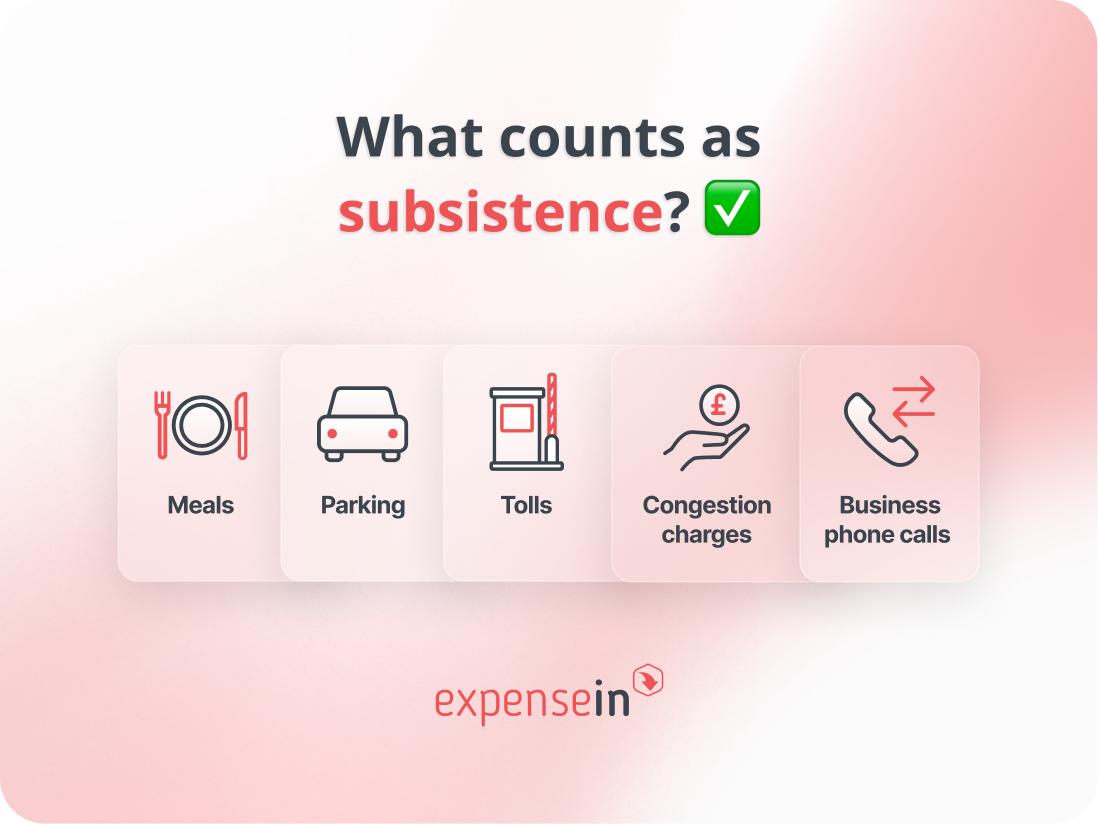 HMRC’s travel and subsistence guidance says this can include meals and other necessary costs of travelling, such as:
Parking charges
Tolls
Congestion charges
Business phone calls
For finance teams, the important point is this: subsistence is linked to business travel. It's not a general daily food allowance, and it does not usually cover ordinary commuting.
Employees can usually receive benchmark subsistence payments, tax and National Insurance-free, only where HMRC’s qualifying conditions are met.
For HMRC benchmark scale rates, the core conditions are that:
The travel is in the performance of the employee’s duties, or to a temporary workplace
The journey is not substantially ordinary commuting
The employee is away from their normal workplace or home for the required continuous period
The employee has incurred the cost of a meal after starting the journey
Appropriate evidence is retained
HMRC’s current benchmark rates are £5 for 5 hours, £10 for 10 hours, and £25 for 15 hours, where the journey is ongoing at 8 pm.
HMRC also says a supplementary £10 rate can apply where a £5 or £10 rate is paid, and the qualifying journey continues beyond 8 pm.
Some claims should be treated carefully, even if the employee was working that day.
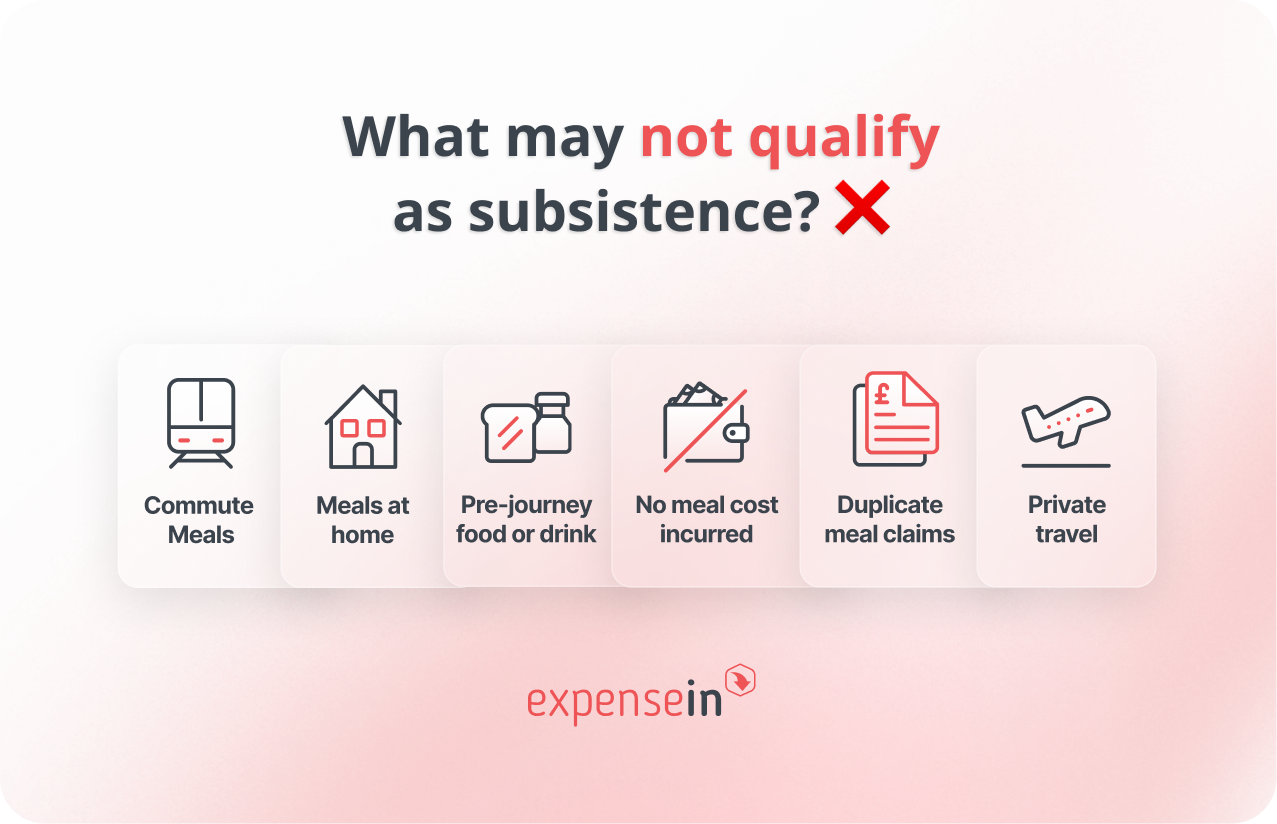 Examples that may not qualify include:
Meals bought during an ordinary commute
Meals eaten at home
Food or drink bought before the qualifying journey started
Claims where no meal cost was actually incurred
A second claim for a meal already included in accommodation or another reimbursed cost
Private or non-business travel
HMRC guidance on ordinary commuting says there is generally no tax relief for travel between an employee’s home and permanent workplace.
HMRC also states that an employee can only be reimbursed for a meal once, so if breakfast or dinner is already included in an overnight stay, the employee would not also be entitled to a benchmark rate for that meal.
This is where policies often get messy.
From 6 April 2019, HMRC’s internal manual says employers using benchmark scale rates no longer need to operate a system for checking the employee’s actual expenditure for those payments.
Instead, employers need to ensure the employee undertook qualifying travel and that there is no reason to know or suspect the travel did not happen.
However, HMRC also says employers must have a system in place to check benchmark or bespoke rate payments, and employees should keep proof of expenses, such as receipts or bills, in case they are needed.
Takeaway: Even where you use benchmark rates, keep a clear audit trail. At a minimum, your process should capture the journey date, destination, business reason, duration, rate applied, and approval record.
They do not usually need to be taxed or reported where they meet the exemption rules.
HMRC says some business travel expenses are covered by exemptions, meaning they do not need to be included in end-of-year reports.
If there is no exemption, the cost must be reported on form P11D, although for business travel, HMRC says there is no tax or National Insurance to deduct or pay in that scenario.
If an employer reimburses more than the necessary cost of business travel, the extra amount counts as earnings and should be processed through payroll for PAYE tax and Class 1 National Insurance.
The safest wording for your policy would be something like:
"Meal allowances may be paid tax and National Insurance free where they meet HMRC qualifying conditions and the company’s expense policy."
That gives finance enough room to deal with exceptions.
It depends on whether the expense is exempt, payrolled, or reportable.
HMRC says taxable expenses and benefits can be reported through payroll or online at the end of the tax year.
If all expenses and benefits are payrolled, employers do not need to submit end-of-year reports for each employee, but still need to submit a P11D(b) for Class 1A National Insurance where relevant.
If benefits are not payrolled, employers must submit a P11D for each employee who received taxable expenses or benefits.
For deadlines, HMRC lists 6 July after the end of the tax year for reporting expenses and benefits, giving employees a copy of the information, and reporting total Class 1A National Insurance owed.
HMRC says employers must keep records of all expenses and benefits provided to employees.
Records should show that end-of-year forms are correct, and HMRC may ask for evidence of how each expense or benefit was accounted for.
HMRC states that records must be kept for 3 years from the end of the tax year they relate to.
For subsistence claims, finance teams should consider keeping:
Date of travel
Start and end point
Business purpose
Duration of journey
Rate claimed
Expense receipt (or e-receipt) or supporting evidence where collected
Approver name and approval date
Notes for exceptions
This also helps when employees query rejected claims, managers apply policy inconsistently, or auditors ask why a payment was approved.
The rules are easier to apply when your policy deals with real examples.
Scenario | Usually claimable? | Why |
|---|---|---|
Employee travels to a client site, is away for 6 hours, and buys lunch after the journey starts | Yes, if the journey qualifies | The journey meets the 5-hour threshold, and the employee incurred a meal cost after starting travel |
Employee buys coffee on the way to their permanent workplace | Usually no | Ordinary commuting is not normally qualifying business travel |
Employee is away for 10 hours, but lunch was provided at the event | Usually no separate meal claim for that meal | The employee should not be reimbursed twice for the same meal |
Employee stays overnight, and dinner is included in the hotel rate | Usually no separate dinner claim | HMRC states a meal can only be reimbursed once |
Employee travels to a temporary workplace for 15 hours and is still travelling at 8 pm | Potentially yes | The £25 rate may apply where all qualifying conditions are met |
Employee claims £10 but did not buy any food or drink | No | A meal cost must have been incurred |
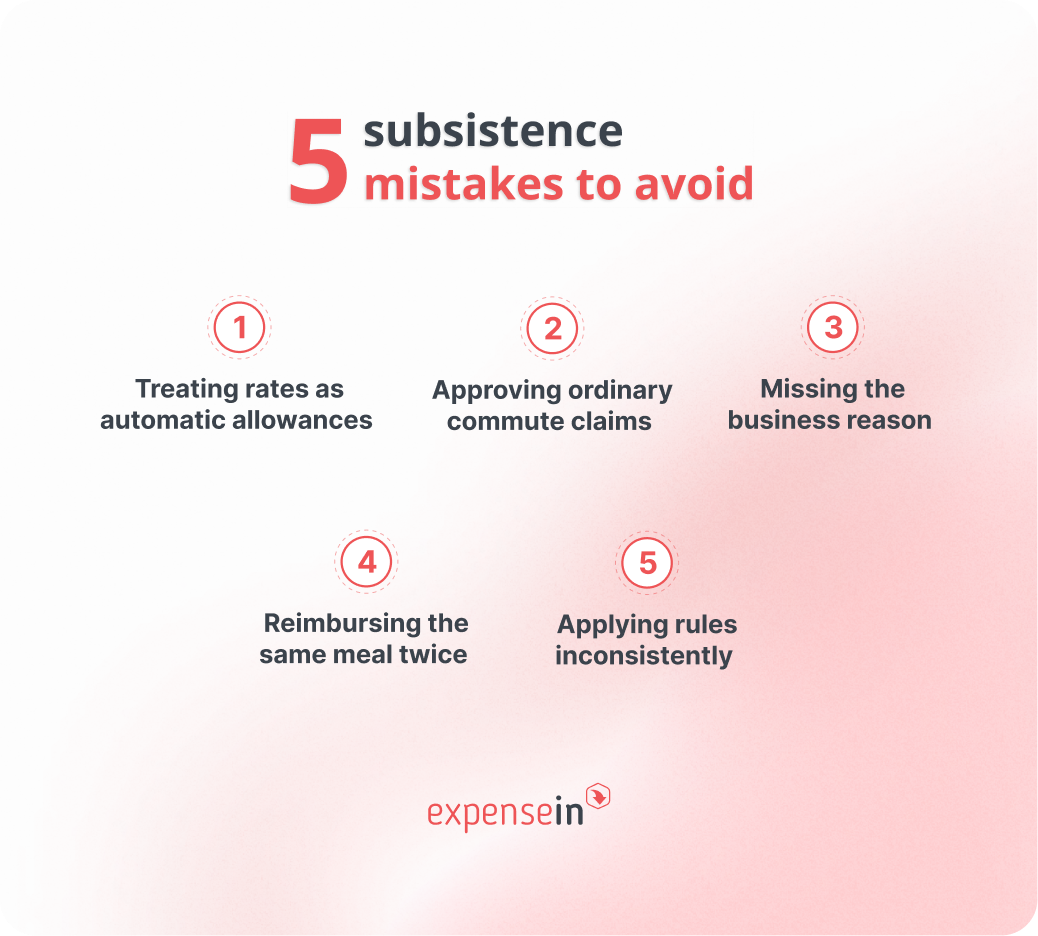
HMRC rates are maximum tax, and National Insurance-free amounts where qualifying conditions are met.
They are not automatic daily allowances for anyone away from their desk.
Travel between home and a permanent workplace is usually ordinary commuting.
That means associated meal costs will often fall outside the tax-relieved business travel rules.
A receipt without context is weak evidence.
The finance team needs to know why the journey happened, where the employee went, and whether it was qualifying travel.
If a meal is included in a hotel rate, event ticket, training course, or travel fare, the employee should not normally receive a separate benchmark meal payment for the same meal.
HMRC states that an employee can only be reimbursed for a meal once.
When one manager approves every claim, and another rejects similar expense claims, employees lose trust in the process.
Clear travel and expense policy rules help finance reduce back-and-forth.
A good subsistence policy should be short enough for employees to follow, but specific enough for managers to apply consistently.
Include:
Which journeys qualify
Which journeys do not qualify
The HMRC benchmark rates your company uses
Whether your company pays the full HMRC maximum or a lower internal rate
What evidence employees need to provide
When receipts are required
How to handle meals included in hotel stays, events or tickets
Approval routes
Deadlines for submitting claims
What happens if a claim breaches the policy
A simple policy line could be:
"Subsistence claims are only payable for qualifying business travel. Employees must provide the journey date, destination, business reason, duration, and any receipts or evidence required by the company policy. Claims for ordinary commuting, private travel, or meals already provided will not be reimbursed."
The UK benchmark rates apply to qualifying business travel within the UK.
For overseas travel, HMRC publishes separate country and city-specific scale rates for meals, accommodation, and related travel costs.
Employers can use these overseas rates, apply for a bespoke rate, or reimburse actual vouched expenses.
If a destination is not listed, HMRC says employers can use the closest city shown for that country, or the closest listed city geographically if the country is not shown.
The UK benchmark rates outlined earlier in this article apply to qualifying business travel within the UK. For overseas travel, HMRC publishes separate country and city-specific scale rates for meals, accommodation, and related travel costs.
The table below gives selected examples from HMRC’s overseas scale rate list.
Last checked: May 2026. Rates can change, so check HMRC’s official overseas scale rate table before approving or reimbursing international claims.
Destination | Currency | Over 5 hours | Over 10 hours | 24-hour rate | Room rate |
|---|---|---|---|---|---|
New York, USA | USD | 31 | 76.50 | 102.50 plus room rate | 216 |
Boston, USA | USD | 32 | 76.50 | 97.50 plus room rate | 239 |
Toronto, Canada | CAD | 46 | 118 | 151.50 plus room rate | 181 |
Vancouver, Canada | CAD | 38.50 | 84.50 | 114.50 plus room rate | 224 |
Paris, France | EUR | 40 | 86.50 | 117 plus room rate | 199.50 |
Berlin, Germany | EUR | 22 | 65.50 | 72 plus room rate | 167.50 |
Beijing, China | CNY | 232 | 563 | 605.50 plus room rate | 1,344.50 |
Singapore | SGD | 91.50 | 206.50 | 218 plus room rate | 318 |
Hong Kong | HKD | 292.50 | 761.50 | 816.50 plus room rate | 2,376.50 |
Finance team tip: If your employees travel internationally often, link your expense policy directly to HMRC’s overseas rate page and make the claim owner responsible for checking the destination rate before submission.
Subsistence claims are small on their own, but messy at scale.
Finance teams need to know whether the journey qualified, whether the meal was eligible, whether the right evidence was provided, and whether the claim followed company policy.
When that information sits across receipts, emails, spreadsheets, and manager comments, simple claims can take longer than they should.
An expense software, like ExpenseIn, helps bring that process into one place.
Employees can submit claims on the go, capture receipts, record mileage, and send expenses for approval.
Managers can review claim details, receipts, and policy flags before approving.
Finance teams get clearer visibility of spend, reporting data and approval records.
For travel and subsistence claims, ExpenseIn can help you:
Capture expenses on the go with a business expense app
Reduce lost receipts with receipt scanning software
Apply claim rules using automated expense policies
Send claims through advanced approval workflows
Track spend with real-time expense reporting
Record business journeys with mileage recording software
Connect expense data through accounting integrations
HMRC subsistence rates are benchmark amounts employers can use to reimburse employees for qualifying meal costs during business travel. They are designed to reduce the need for employers to agree bespoke rates with HMRC, provided the qualifying conditions are met.
The current UK benchmark meal rates are £5 for a qualifying journey of 5 hours, £10 for 10 hours, and £25 for 15 hours, where the journey is ongoing at 8 pm. A supplementary £10 rate may apply where a £5 or £10 qualifying journey continues beyond 8 pm.
Usually, no. HMRC says ordinary commuting generally means travel between home and a permanent workplace, and there is no tax relief for ordinary commuting costs.
For benchmark scale rates, HMRC’s internal manual says employers no longer need to check actual expenditure from 6 April 2019, but employers still need to ensure qualifying travel happened.
GOV.UK also says employees should keep proof of expenses, such as receipts or bills, in case they are needed.
They can be paid tax and National Insurance free where the qualifying conditions and exemption rules are met.
If payments exceed the allowable amount without a bespoke HMRC agreement, the excess may be taxable and subject to National Insurance.
Book a free demo of ExpenseIn today to see how ExpenseIn can help streamline your travel and subsistence expense processes.
Learn everything there is to know about employee travel expenses, including what workers can claim, the benefits of a travel and expense policy, and more.

