
Business Expenses
Best Expense Management Software Reviewed [2026]
Compare the best expense management software for businesses in 2026. Review the top 5 tools for receipt capture, approvals, mileage, reporting, integrations, and finance control.
The Office for National Statistics processed 36,440 expense claims worth £1.6 million in one financial year.
That is the reality of employee expenses: hundreds, thousands, sometimes tens of thousands of small claims that all need the right evidence, approval, coding and audit trail.
HMRC also requires employers to keep records for every expense and benefit they provide, including enough detail to show accurate reporting.
So while expense claims may look routine, they are anything but.
When receipts go missing, claims arrive late, or managers approve spend without context, finance teams are left chasing evidence, checking tax treatment and trying to keep expense reimbursements moving without slowing down month-end.
An expense claim is a request from an employee to be reimbursed for approved business expenses they paid for personally.
In many organisations, employees submit them through an expenses mobile app or expense claim software, so finance teams can capture receipts, check policy and keep a clear audit trail.
Typical examples include:
Accommodation for overnight business trips
Meals and other subsistence during qualifying business travel
Mileage in a personal vehicle
Office or work-related supplies
Training or certification costs where covered by the company expense policy
HMRC treats different expense types differently for tax and reporting purposes, so "business expense" does not automatically mean "tax-free" or "exempt."
Employers need to assess whether a specific expense is exempt, reportable, or taxable.

If expense claims are late, incomplete or miscoded, your reporting is off.
That means weaker visibility over departmental spend, project costs and cash flow.
Using expense reporting software can help finance teams keep claim data cleaner, more consistent and easier to review.
Employees should not have to wait weeks to be paid back for legitimate business spend.
Slow reimbursement creates friction fast, especially when staff are regularly covering travel or client costs themselves.
HMRC requires employers to keep records that support expenses and benefits, including the reason for travel and, where possible, receipts.
Those records must usually be kept for 3 years from the end of the tax year they relate to.
Expense claims sit in a part of finance where small errors and low-value misuse can slip through when processes are manual.
Broader UK fraud losses remained above £1.1 billion in 2024, underlining the pressure on finance controls generally.
Stronger employee spend management gives finance teams more control over what is being claimed, approved and reimbursed. Real-time expense reports can also make it easier to spot unusual patterns before they become bigger issues.

Travel is one of the most common claim categories. Employee travel expenses can include:
Rail, air or taxi fares for business travel
Hotel or overnight accommodation
Parking, tolls and congestion charges
Meals and other subsistence while travelling for work
HMRC guidance says travel and subsistence can include reimbursed travel, accommodation where an employee needs to stay away overnight, meals, and necessary travel-related costs such as parking, tolls, congestion charges or business phone calls.
Good practice: Require pre-approval for higher-cost travel, capture the business purpose, and set clear policy limits by role or trip type.
If employees use their own vehicle for business travel, they may submit mileage claims rather than claiming fuel directly.
For 2026, HMRC’s approved mileage allowance payments remain:
Cars and vans: 45p per mile for the first 10,000 business miles in the tax year, then 25p
Motorcycles: 24p per mile
Bicycles: 20p per mile
Passenger payment for cars and vans: 5p per passenger per business mile for qualifying work journeys with fellow employees
Accurate mileage expense reports should include the journey date, destination, mileage, business purpose and any required supporting evidence.
Good practice: Require mileage logs with date, destination, purpose and distance. Mileage should be based on business journeys only, not commuting.
This is where many policies get messy.
Meals can be reimbursable when they are part of qualifying business travel. Client entertainment is different again, with separate tax and reporting considerations depending on who was entertained and how the expense was arranged.
HMRC’s guidance is explicit that entertainment expenses can trigger tax, National Insurance and reporting obligations.
Good practice: Separate these categories in policy. "Business meals while travelling" and "client entertainment" should not sit under one vague heading.
Employees sometimes buy smaller work items personally and reclaim them later. These ad hoc expenses might include stationery, equipment, or work-related items that were needed quickly but not purchased centrally.
HMRC includes office equipment and supplies in its guidance, though tax treatment depends on how they are provided and whether an exemption applies.
Good practice: Define what is reimbursable, what should be purchased centrally, and what needs manager approval first.
Training claims can include course fees, certifications and related costs.
HMRC guidance confirms there are specific tax and reporting rules for employer-funded training, and exemption depends on whether the training is genuinely work-related rather than reward-led.
Good practice: Tie training claims to role relevance, manager approval and a defined learning budget.
 A workable expense process should be simple for employees and controlled for finance.
Whether you manage claims manually or through an expense management system, the same core steps apply.
Your policy should answer the questions employees ask before they spend, not after.
An expense policy template can help you cover the basics, but the final version should reflect how your business actually buys, approves and reimburses spend.
Include:
What counts as a business expense
What is not reimbursable
Approval rules by amount or category
Mileage rates and travel rules
Receipt and evidence requirements
Submission deadlines
Treatment of exceptions
Who approves what
How and when reimbursements are paid
This is where many businesses save time. If policy is unclear, finance ends up reviewing the same judgment calls again and again.

The later a receipt is submitted, the more likely it is to be lost, duplicated or stripped of context.
Employees should capture:
Receipt or invoice
Date of spend
Merchant
Amount and currency
Business purpose
Attendees, where relevant
Project, cost centre or department
HMRC says employers need records that show what the expense was for and, where possible, receipts as evidence.
An online expenses system can help keep that evidence attached to the claim from the start.
Approvals should reflect risk, not just hierarchy.
For example:
Low-value routine claims: Line manager approval
Travel and subsistence: Line manager plus policy check
Client entertainment or exceptional spend: Finance review
Out-of-policy claims: Escalated approval
This reduces rubber-stamping and makes exceptions visible earlier.
Finance should not assume every approved claim is exempt from reporting.
HMRC states that employers usually need to report expenses and benefits to HMRC and pay tax/NIC unless an exemption applies.
That is why policy rules, category controls and clean records matter.
They make it easier to separate standard reimbursable spend from expenses that may need additional treatment.
Once approved, claims should move to reimbursement without unnecessary delay.
The longer the gap between approval and payment, the more employee trust drops and the more queries finance has to handle.
Just as important: keep the claim, evidence, approval record and export trail together.

Most policies cover flights, hotels and mileage. Fewer cover hybrid working, ad hoc software, one-off purchases, or mixed business/personal receipts.
That is where disputes happen.
Add examples. Spell out what "reasonable" means. Clarify what needs approval in advance.
Not every business cost should be reclaimed after the fact.
Recurring online spend, team purchases and pre-approved travel are often better handled through controlled payment methods, such as company expense cards, rather than employee reimbursements.
That reduces out-of-pocket spend and gives finance more visibility before money goes out.
If every employee describes the same expense differently, reporting quality drops.
Use standard categories such as:
Travel
Accommodation
Mileage
Subsistence
Entertainment
Office supplies
Training
That makes policy checks, audit reviews and month-end reporting much easier.
A £12 taxi should not follow the same route as a £1,200 client dinner.
Risk-based workflows speed up routine claims while still tightening control where it matters.
Look for:
Repeated out-of-policy claims
Late submissions
Duplicate merchants or duplicate amounts
Overspend by team or project
Categories with the most exceptions
Frequent manual corrections by finance
This turns expense claims from a reimbursement task into a useful source of spend insight.
Expense tracking software can make this easier by helping finance teams review patterns across claims, categories and teams.
Policy only works if employees remember it at the point of spend.
Short reminders work better than long policy documents. Use examples, submission tips and simple "before you buy" guidance.
Finance teams now need to think beyond blurry photos and altered PDFs. Recent reporting has highlighted a rise in AI-generated fake receipts and invoices, making manual visual checks less reliable on their own.
That does not mean every claim is suspicious. It means process design matters more:
Require contextual data, not just a receipt image
Match claims against policy and transaction data
Flag duplicates and unusual patterns
Keep clear audit trails
The admin-heavy parts of expense claims are usually the least strategic:
Receipt capture
Chasing missing fields
Routing approvals
Checking policy
Exporting data
Reconciling records
That is where expense management software helps most.
Managing expense claims well means more than reimbursing employees quickly. It means making claims easier to submit, giving managers clearer approvals, and reducing avoidable out-of-pocket spend where company cards make more sense.
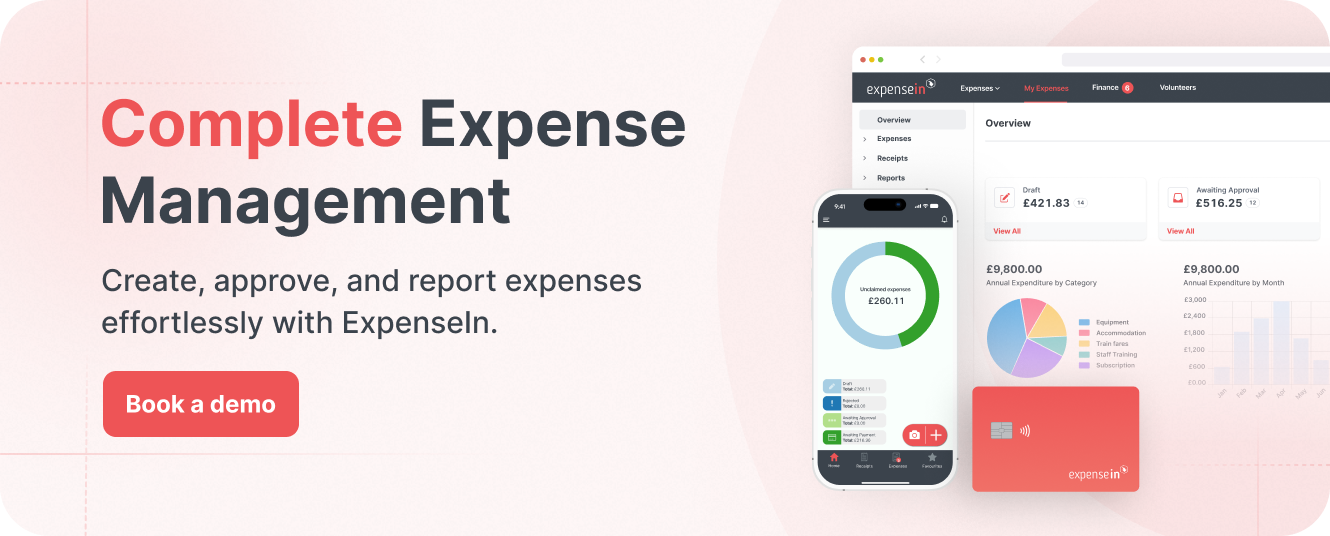
ExpenseIn brings those parts together in one place.
Employees can submit purchase, mileage, and time-based claims through the mobile expense app, with receipt scanning and real-time claim updates.
Approval workflows and policy controls help finance teams review claims more consistently and keep a clearer view of spend.
Managers can monitor and approve expense and mileage claims in one place.
Business expense cards help reduce unnecessary reimbursements by giving employees a controlled way to pay for business expenses directly.
Virtual expense cards can be issued instantly with configurable limits, expiry dates, category controls, and support for Apple Pay and Google Pay.
That means finance teams can manage the claims that still need reimbursing, while reducing admin on the spend that is better handled through company cards.
Usually genuine business costs paid personally, such as:
Qualifying travel
Accommodation
Mileage
Subsistence
Work-related supplies
Approved training
Whether an expense is reimbursable under company policy is separate from whether it is tax-exempt under HMRC rules.
In practice, yes wherever possible. HMRC says employers should keep records showing what the expense was for and, where possible, receipts as evidence.
HMRC says records must usually be kept for 3 years from the end of the tax year they relate to.
No. Meals may be reimbursable under company policy, but tax treatment depends on the circumstances.
HMRC draws a distinction between travel and subsistence on one hand, and entertainment on the other.
Compare the best expense management software for businesses in 2026. Review the top 5 tools for receipt capture, approvals, mileage, reporting, integrations, and finance control.

